FH:FOS对冰雪宇宙的重要性
来源:群内发布的 Word 文档《FOS-Related Analysis》(英文原文)与《FOS-Related Analysis(个人翻译)》(中文翻译),2026-08-26 收录整理。原文图片按文档原位置存放于 assets。
英文原文(FOS-Related Analysis)
Why Forest of Shadows is of High Importance for the Frozen Universe
The importance of Forest of Shadows (FOS) can be shown in mainly three aspects: its high canonicity, its role of building transitional pieces of the character arc of the sisters, and its role in the franchise on a broader view.
Canonicity
First, the process of writing this novel was under the supervision of the core creative team of the movies. Also, the initial purpose of the novel was to craft a bridge between the movies, which they successfully did. The novel used many deleted scenes and settings that didn’t make it into F2, however, there are some differences in minor details between the novel and the movies. Still, it is not the reason why portrayals here should be fully denied, but it is important to make sure the portrayal is consistent when referencing the novel. The differences are reasonable, considering the short amount of time when F2 was being produced, as well as the fact that Frozen official books (A Frozen World, Frozen 2 Magical Guide, etc.) published at the same time also had similar problems. Thus, we can take FOS as “Frozen 1.5” when considering the storyline, as its setting and character portrayal are both expanded from the worldview of the movies.
Elsa’s Character Arc
Elsa’s character arc through FOS is the development of her mindset from pretending having no fear and shouldering everything on her own to realization that “fear is the shadow of love” and that having fear and needing help doesn’t mean incapability in any way.
Trained to be the Queen of Arendelle, Elsa always does everything on her own. Sense of responsibility as a Queen is only one factor for this, more importantly, she wants to make amends. She still feels guilty for Anna not getting a childhood she could have had, so she is trying to “prolong” Anna’s childhood. Also, the people forgave her after the accident on Coronation Day, and they embraced her and her magic soon. Elsa feels that she owes the people for this, so she would do her best on her own for the people. Specifically during what happened in FOS, there’s another reason that fosters this mindset: the Grand Tour. Elsa plans to let Anna take care of Arendelle while she is away, which can be a heavy burden for Anna already. Elsa doesn’t want to stress her more.
With daily national affairs, planning for the Grand Tour, as well as Anna’s promise to the villagers to solve the Blight in three days, heavy pressure accumulates in a short time. Due to
the 13-year isolation, Elsa is used to keeping everything to herself; as an introvert with limited contact with people, she doesn’t feel comfortable at social events. However, in order to maintain Arendelle’s national image, she has to keep this tradition going. While she’s not home, there must be someone reliable to take care of Arendelle —- and this person can only be Anna. Although Elsa can always put up the appearance and pretend to be fine, she is nervous inside all the time. Going to new places for international events without her only comfort, Anna, only worsens the situation. Also, the Blight affecting the animals and crops further deepens Elsa’s fear of being irresponsible and unqualified as a Queen. Short-term pressure and long-term leftover mental problems combined lay the foundation of the manifestation of Nattmara: fear.
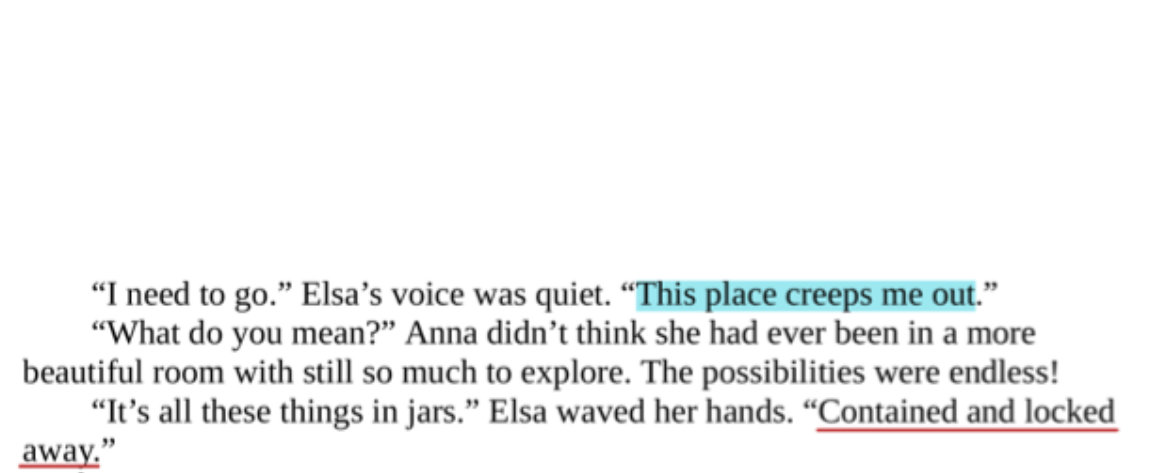
Elsa’s deepest fear in FOS is being a bad queen. It develops from Elsa knowing about the Blight and finding out that her magic is not helpful under this circumstance. This is evident in Chapter 4, when the sisters are in the Secret Room.
In F1, Elsa’s magic caused damage to Arendelle and almost led to an eternal winter. While here, when there is a problem related to myths and magics, her magic can’t help at all. This circulates her back to her old mentality, thinking that her magic was so should be, like the things in jars here, “contained and locked away”. Elsa is afraid that the research about her magic proves that she is actually the curse for Arendelle. If she finds the evidence, it would crash her and there would be no way to recover. She doesn’t want to admit it, so she’s trying extremely hard to prove herself not being the curse. But she has completely no idea how, so her fake determination of proving the prophecy wrong is leading her to despair. With the belief of not
being ought to show a hint of weakness, her stress and despair is not directly expressed, but turned into self-blame and deeper fear.
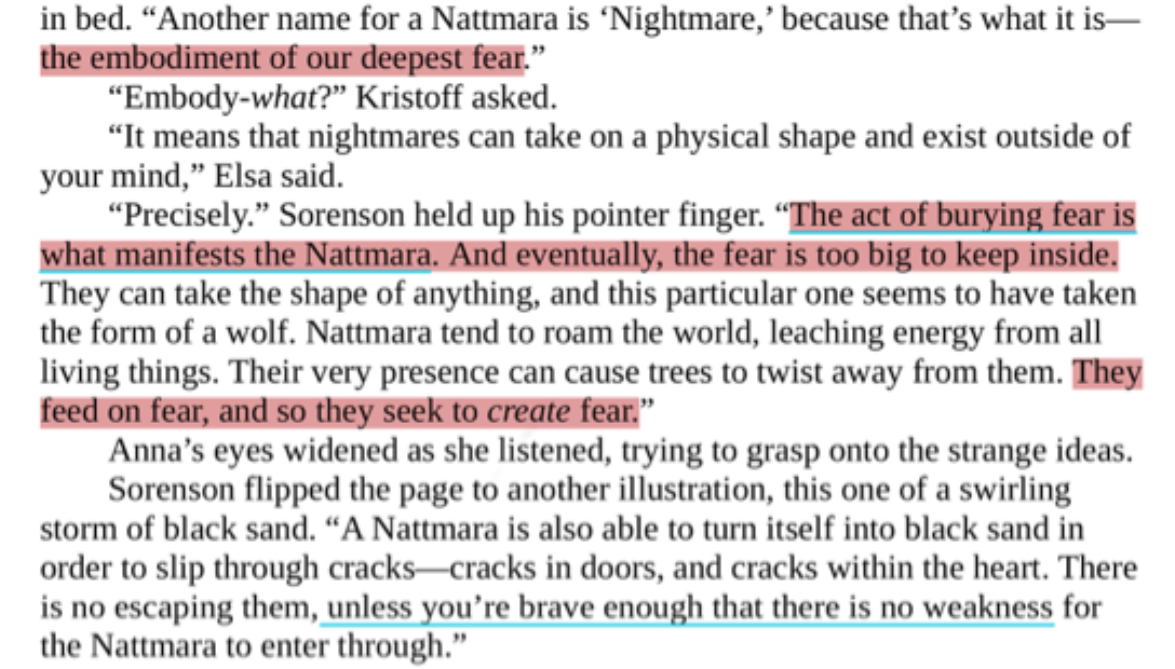
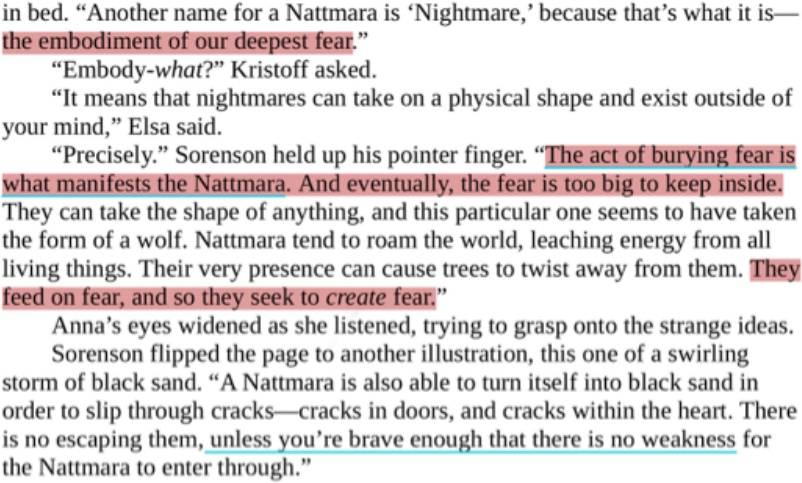
In Chapter 14, Sorenson points out that “Nattmara is the embodiment of our deepest fear”.
There are two sentences worth noticing:
- “The act of burying fear is what manifests the Nattmara.”
- “…unless you’re brave enough that there is no weakness for the Nattmara to enter through.” For Elsa, who always takes all responsibilities on herself, she would naturally consider it’s her job to save her family and the kingdom. The combination of what she’s been taught all these years to carry the queenly responsibilities and Sorenson saying “unless you’re brave enough that there is no weakness” further shapes her demanding herself that ‘only if I have no weakness and no fear can I become a good and qualified queen’. At the same time, being told to ‘conceal, don’t feel’ since eight years old might already let her forget how to share her fear and burdens with others. Even though she doesn’t need to hide her magic now after the Great Thaw, it’s almost in her subconscious mind that she needs to ‘shoulder it all’. Elsa is trying to act strong, pretending to have no weakness so that she can defeat the Nattmara, while this is exactly ‘burying/ ignoring/ fighting her fear’.
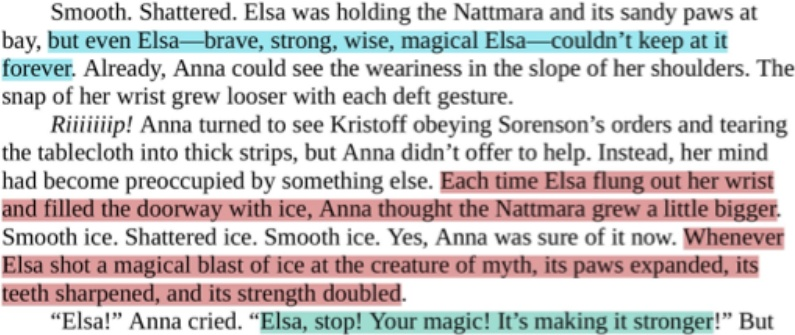
Similar evidence can be found in Chapter 15. In the secret room, Elsa fears that her magic is the curse, since it almost turned Arendelle into an eternal winter, and when people need her magic, it can’t help. Elsa trying to fight the Nattmara with her magic is trying to prove to
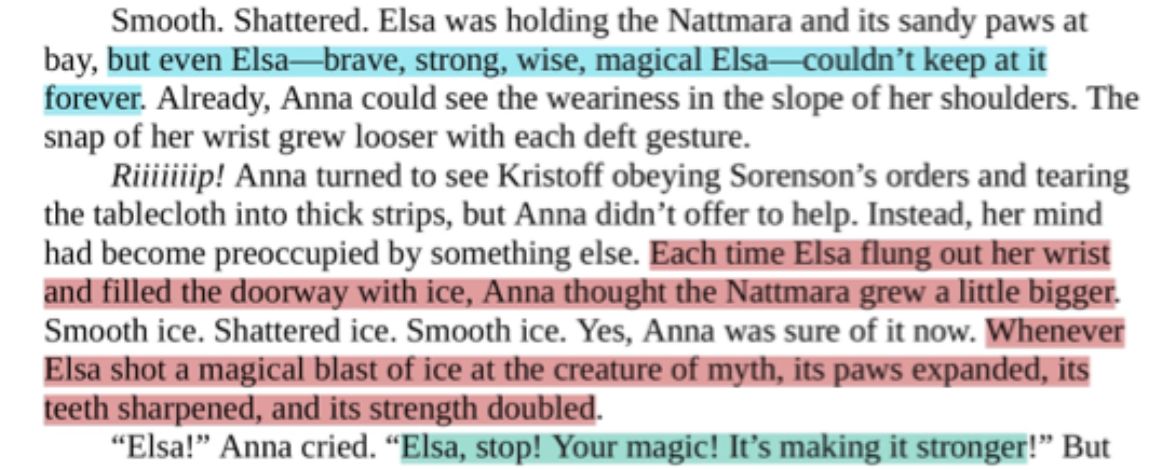
herself that it can be helpful, but this is the act of burying her fear, which makes the Nattmara grow.
In Chapter 25, the solution is revealed: “Fear is the shadow of love”. Anna sees through Elsa’s nightmare, and helps Elsa face and accept her fear, telling her that she’s always been a good Queen. When Elsa no longer fights against her fear, the manifestation shatters with her finally letting go.
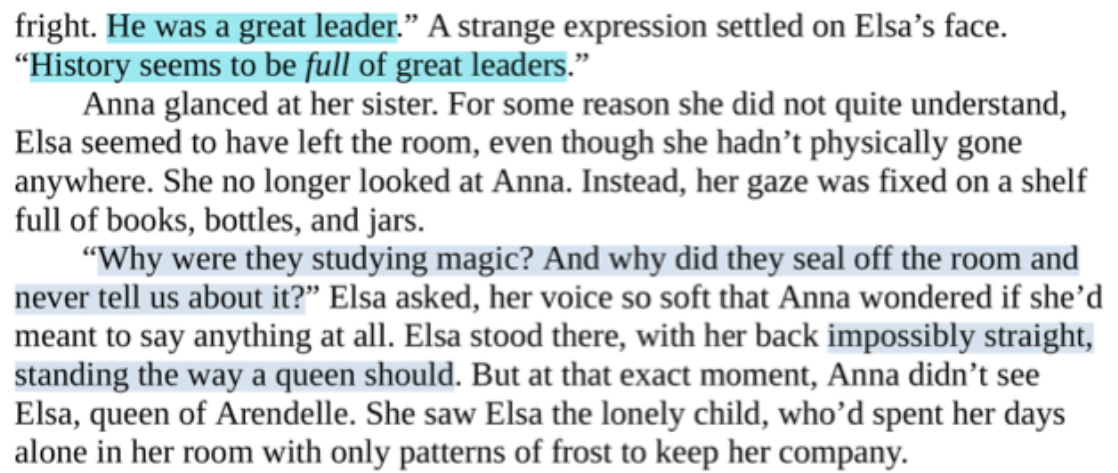
Elsa’s mental journey in FOS also connects her character arc between F1 and F2. It adds a lot more portrayal of Elsa’s sense of responsibility which is not elaborated in F1, and to a certain extent explains Elsa’s actions and decisions in F2. In Chapter 4, when Elsa saw Aren’s portrait, she admired, “He was a great leader. History seems to be full of great leaders”. Comparing herself to leaders in the past, she feels small and disappointed that she could never be as great as them—especially Aren, who courageously saved the people with a thing of myth. As someone who also wields magic, Elsa thinks that she should be as great as Aren, but her power not only can’t help practically when the people are in need, it even brought danger to Arendelle. This along with her sense of responsibility deepens her fear of being a bad Queen, and also pushes her to think about her magic’s greater goal. It sets the foundation for Elsa’s strong motivation in F2 to follow the voice and discover what her power is really for, thus fulfilling her character arc.
Anna’s Character Arc
Anna’s portrayal in FOS connects from F1 and leads to F2 to complete her character arc. In FOS, Anna’s deepest fear is losing her sister.
According to the creative team, the “negative trait” of Anna is codependency. For the enabler in a codependent relationship, they define their worth through others’ need and validation. Without the other individual, they can’t find the purpose of life. For Anna, all the purpose of her being is to help Elsa, which is portrayed a lot in FOS. For example, in Anna’s dream in Chapter 5, Hans, who later turned into a wolf, tells Anna that “she has no use for you”. Similarly, in Chapter 7, Anna chants the secret spell, which she believes could make her dream come true. After Anna hears Elsa’s secret meeting, she has a nightmare in which she is replaced but no one notices. (“Or maybe they did and they simply did not care. … Instead, the wolf flipped her over onto her back, opened its huge jaws, and swallowed her whole.”) It is shown that Anna’s dream is to be helpful to Elsa, and that her deepest fear is being useless to Elsa and not needed anymore, as Nattmara is the manifestation of fear.
This idea of codependency directly links into F2, when Elsa is frozen in Ahtohallan and Anna decides to “do the next right thing” in The Next Right Thing. This explains the core reason why Anna qualifies as the Queen of Arendelle after breaking the dam. Before, Anna believes that all her being is to help and support Elsa, that she would be fulfilled emotionally and professionally as long as Elsa achieves her goals. But when she thinks that she has lost Elsa forever, she still does the next right thing, not for helping Elsa but for her people, but independently makes the right choice. This lets Elsa know that Anna has the ability to “always do what’s best for Arendelle”, and proves to Ahtohallan that Anna is competent as the human side of the bridge.
Role in the Franchise
FOS links important threads from F1. It continues the theme of love vs. fear, and elaborates from a new perspective. The concept of Nattmara and its manifestation is not only for an introduction of Northern legends, but a tool to portray what slips unnoticed. The wolf is the embodiment of Elsa’s own fear, and what resolves it, again, is TRUELOVE. When Anna sees into Elsa’s nightmare and lets her know that she’s a great queen and her role model all the time, Elsa accepts her fear and embraces who she is, which does not defeat, but manages Nattmara. This connects to the overall main idea of the Frozen franchise: What matters is not superficial outcomes, but the development of attitude and mentality. In F1, the great thaw is achieved by the true love between the sisters; in Frozen Fever, Anna’s favorite gift is being able to take care of Elsa; in FOS, the way to solve the Nattmara is seeing and accepting fear; in F2, the forest is freed not for Arendelle being washed away, but the sisters’ realization and determination to right the wrong. As a building block, FOS is an essential part for various aspects such as plots, character arc development, and theme elaboration. Thus, it is important to be taken into account for Frozen analysis.
Potential Questions and Refutations Regarding Forest of Shadows and Responses
- The sisters’ relationship hasn’t improved since F1, and their mindsets haven’t progressed either.
- Regarding the comics that portray the sisters’ daily life during the three years: It is true and desirable that they are getting closer, and spending more time with each other. However, becoming friends and being able to help each other on daily stuff is not the same as being able to tell each other their deepest fear, especially for Elsa’s personality. It is completely reasonable for them to take three years to open up to this extent, given the 13-year separation before.
- Special circumstance because of the Blight and the coming Grand Tour
- Elsa’s internal struggle of whether taking Anna with her: conflict between ration and emotion
- Elsa’s stress, both from state affairs and from her own mental issues
- Elsa’s portrayal is out of character.
Arguments of Elsa being out of character are mainly generated due to Elsa’s seemingly sharp languages.
Take some representative examples:
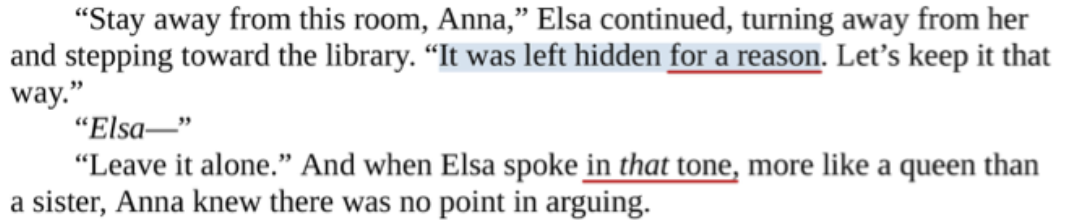
- Chapter 4
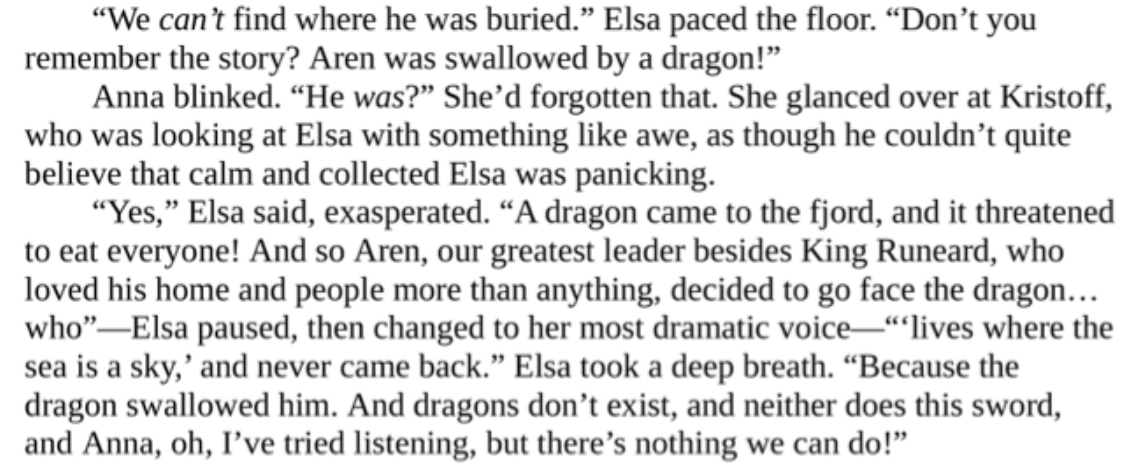
Here, Elsa’s tone is similar to the coronation scene in Frozen 1, strong and fierce with no room for arguing. The detailed reason will be elaborated later.
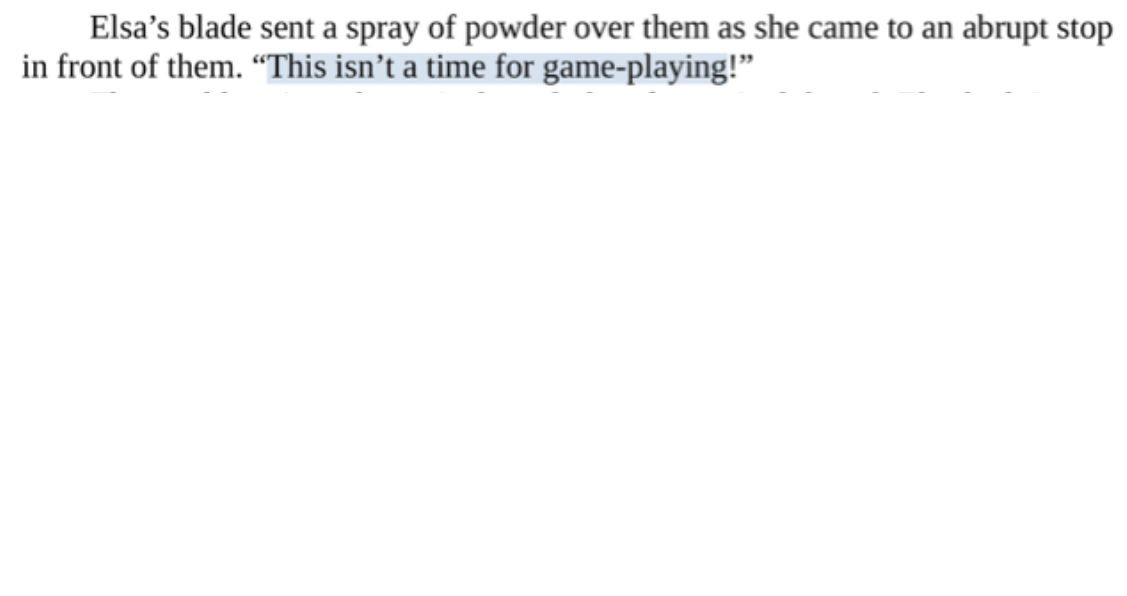
- Chapter 12
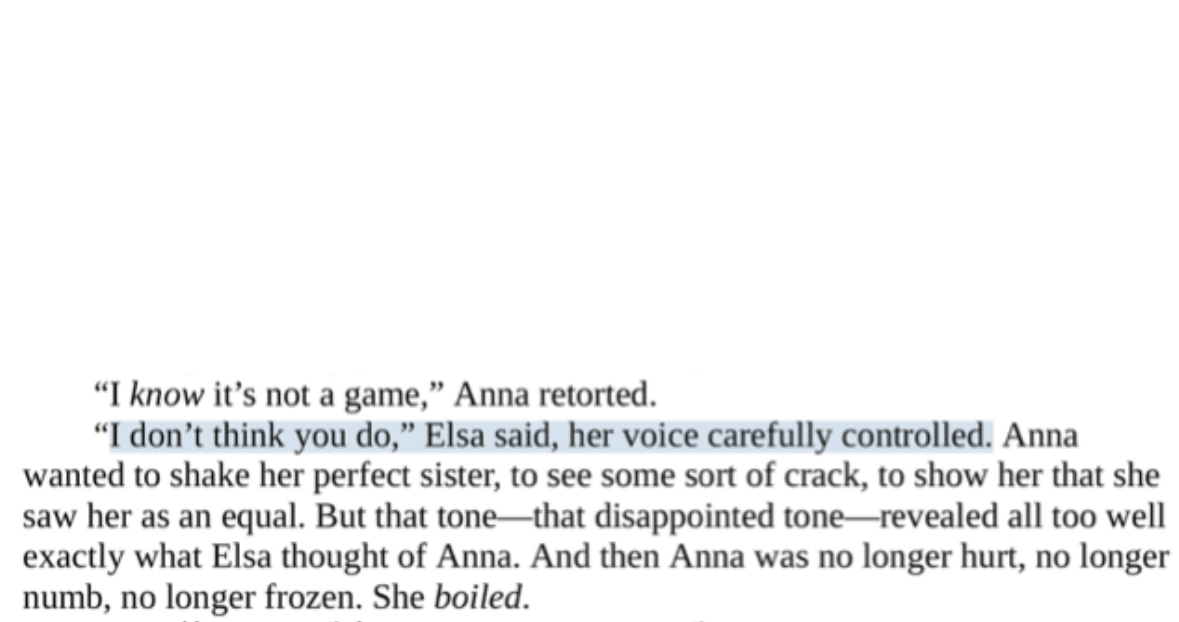
Chapter 13
In this scene, Elsa is facing a real urgent issue, pressure is getting on her nerves. However, she can’t show that she is stressed out, since she believes that a successful leader should have no weakness.
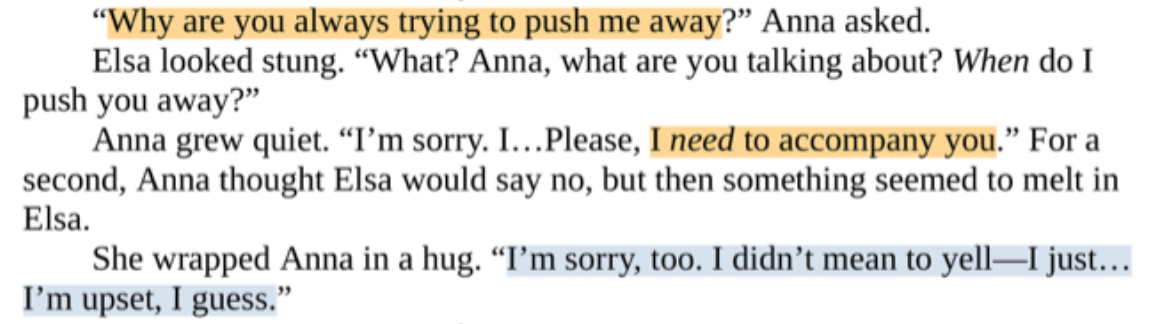
- Chapter 19

In this case, Elsa is desperate because the last hope of saving Arendelle is fading into nothing. She is feeling useless because she fails to find Revolute, leading her to failing to save Arendelle which reinforces to herself thinking that she is not a good Queen.
Throughout the book, when Elsa’s emotion grows so intense that she “doesn’t sound like Elsa”, she is trying desperately to prove that she is a good leader instead of the abomination of the whole country. Elsa’s seemingly weird expressions in FOS is not the writer’s misportrayal, but the result of fear developed from the combination of short-term stress and long-term mental issues.
- There’s a limitation on narration because it’s from only Anna’s perspective. (which is true!)
- Plot consideration: One of the main plot twists in FOS is from whose nightmare manifests the Nattmara. If the narration is written from Elsa’s perspective, the answer would be revealed at the start of the story.
- FOS from Anna’s perspective is dark enough already; it would be too depressing to read for young kids if it was written from Elsa’s perspective.
中文翻译(FOS-Related Analysis 个人翻译)
为何《暗影森林》对《冰雪奇缘》宇宙至关重要
《暗影森林》(FOS)的重要性主要体现在以下三个方面:其高度的正典性、其在构建姐妹角色弧光方面所起到的过渡性作用,以及从更宏观的角度来看其在整个作品体系中起到的作用。
正典性
首先,这部小说的创作过程是在电影核心创作团队的监督下完成的。此外,这部小说最初的目的是为了在两部电影之间搭建一座叙事桥梁,而且这一目标也成功实现了。小说中使用了许多未被纳入《冰雪奇缘2》的删减场景和设定,但同时,小说与电影在一些细节上却存在差异。但这并不是意味着小说中的描绘就应该被全盘否定,只是在参考小说内容时,要确保其与电影中描绘的一致性。考虑到《冰雪奇缘2》的制作周期较短,以及同期出版的官方书籍(如A Frozen World, Frozen 2 Magical Guide等)也存在类似的问题,所以存在差异的现象是可以理解的。因此,从故事情节的角度来看,我们可以将《暗影森林》视为”冰雪奇缘1.5”,因为它的背景设定和人物塑造都是在电影世界观的基础上进行的拓展。
艾莎的人物弧光
在《暗影森林》这部作品中,艾莎的人物弧光就在于其心态的转变,从一味地假装无所畏惧、凡事都独自承担,到逐渐领悟到”恐惧是爱的影子”,并意识到有恐惧感和需要帮助并不意味着自身能力的不足。
艾莎从小就被培养成阿伦戴尔的女王,凡事都是亲力亲为。身为女王的责任感只是其中的一个因素,更重要的是,她想要弥补过错。她仍为安娜没能拥有一个本应拥有的童年而感到内疚,所以她试图尽力”延长”安娜的童年时光。而且,在加冕日那天的意外发生之后,人们很快就原谅了她,并很快的接纳了她和她的魔法。因为这件事,让艾莎觉得自己亏欠了人民,所以她会尽自己最大的努力为人民服务。特别是在《暗影森林》中发生的事情里,还有另一个原因促使她形成了这种心态:巡游之旅。艾莎打算在自己外出期间让安娜来管理阿伦戴尔,这对安娜来说可能是一个不小的负担。所以,艾莎不想再给她增添压力了。
由于需要处理每日繁忙的政务,还要筹备巡游之旅,再加上安娜向村民们承诺要在三天之内解决枯萎病,这让艾莎在短时间内承受了巨大的压力。而在长达13年的与世隔绝的生活中,艾莎习惯了凡事都独自承受;作为一个性格内向、与人交往甚少的人,她在参加社交活动时会总是感到不自在。然而,为了维护阿伦戴尔的国家形象,她不得不去延续这一传统。当她不在家时,必须得有一位可靠的人来照管阿伦戴尔——这个人只能是安娜。尽管艾莎总是能装出一副若无其事的样子,但是她的内心却一直很紧张。在前往陌生地点并参加国际活动时,缺乏安娜这一重要精神支柱的陪伴,无疑会加剧她的不安情绪。此外,灾祸对动物和农作物造成的严重影响,也进一步加深了艾莎对自己作为女王是否称职的怀疑与恐惧。短期的压力和长期遗留的心理问题相结合,为纳特玛拉(Nattmara)的显现奠定了基础:恐惧。
在《暗影森林》里,艾莎内心深处最大的恐惧就是无法成为一名称职的女王。这种恐惧源自于艾莎知晓了灾祸的存在,同时还发现了自己的魔法在这种情况下却毫无用处。这一点在第4章中表现得很明显,当时姐妹俩在密室里。
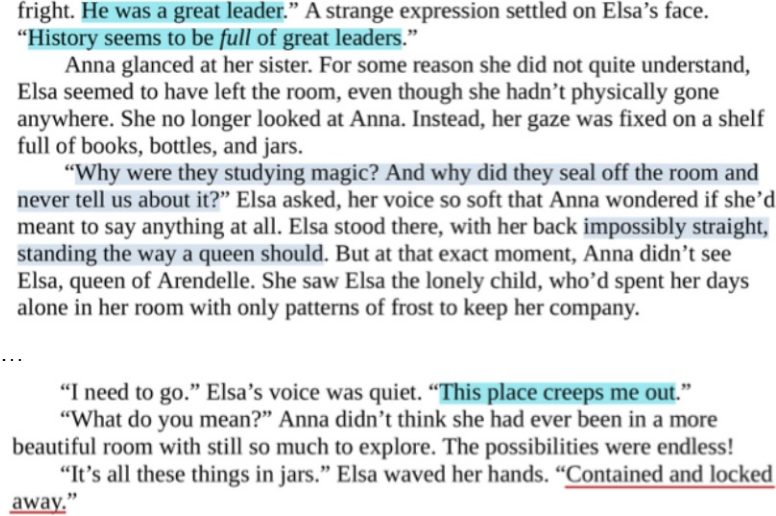
在《冰雪奇缘1》里,艾莎的魔法曾给阿伦戴尔造成了破坏,差点让那里陷入了永恒的冬天。然而,在当前情境下,在面对与神话和魔法相关的问题时,她的魔法却毫无用处。这一现象又让她重新陷入了过去的心态,认为自己的魔法就应该如同这罐中之物一般,“被封存、被禁锢”。艾莎害怕对她魔法的探索会证明她实际上就是阿伦戴尔所遭受诅咒的根源。一旦她找到了相对应的证据,那这将会让她崩溃,并且再也无法挽回。她不愿意承认这一点,所以竭尽全力证明去自己并非诅咒。但她完全不知道该怎么做,所以她那假装要推翻预言的决心正将她引向绝望的深渊。基于她那不应显露任何软弱迹象的信念,这使得她的焦虑和绝望并没有直接表露出来,而是转化成了自责和更深的恐惧。
在第14章中,索伦森指出:“纳特玛拉是我们内心最深处恐惧的化身。”
这里有两句话值得注意:
- “将恐惧深埋之日,便是纳特玛拉显形之时。”
- ”……除非你足够勇敢到毫无弱点可言,这才能让纳特玛拉失去任何可乘之机。”
对于艾莎来说,她总是把所有责任都揽在自己身上,因此她会很自然的认为拯救家人和王国是她的职责所在。多年来所受的教导使她对作为女王所需要承担的责任有着很深刻的理解,再加上索伦森说的”除非你足够勇敢到毫无弱点可言”,这进一步促使她要求自己”只有我毫无弱点、毫无畏惧,才能成为一位出色且称职的好女王。“与此同时,从八岁起就被告知”隐藏起来,别去感受”,这或许已经让她忘却了如何与他人分享自己的恐惧和负担。尽管在大解冻之后她已无需再隐藏自己的魔法,但”独自承担一切”的观念几乎已深植在了她的潜意识当中。艾莎试图表现得坚强并假装自己毫无弱点,以便能战胜纳特玛拉,然而这恰恰是”埋藏/忽视/对抗自己的恐惧”。
在第15章中也能找到类似的证据。在密室里,艾莎担心自己的魔法就是诅咒,因为它差点让阿伦戴尔陷入永恒的寒冬,而且当人们需要她的魔法时,它却帮不上忙。艾莎试图用魔法来对抗纳特玛拉,这是她想向自己证明魔法是有用的。然而,这种试图掩盖内心恐惧的方式却反而促使纳特玛拉变得愈发强大。
在第25章中,解决方法被揭晓:“恐惧是爱的影子”。安娜看透了艾莎的梦魇,并帮助艾莎直面与接纳了自己的恐惧,同时告诉她一直以来都是一个出色的女王。当艾莎不再与恐惧抗争时,恐惧的具体表现也随着她最终的释怀而彻底消散。
在《暗影森林》中,艾莎的角色弧光与她在《冰雪奇缘1》和《冰雪奇缘2》中的角色发展轨迹相连接。这为艾莎的责任感增添了更多刻画,弥补了《冰雪奇缘1》中对这方面的简略阐述,并为她在《冰雪奇缘2》中的行为和决策提供了一定程度上的合理解释。在第4章中,当艾莎看到阿伦的画像时,她赞叹道:“他是一位伟大的领袖,历史中似乎总是充满着这样的伟大人物。“通过将自己与过去的领袖们进行对比,这让她对自己感到了自卑和失望,觉得自己永远无法像他们那样伟大——尤其是阿伦,他凭借一件具有神话色彩的物品勇敢地拯救了人民。作为同样拥有魔法的人,艾莎认为自己应该像阿伦那样伟大,但她的魔法不仅在人民需要时无法实际发挥作用,甚至还给阿伦戴尔带来了危险。这种无力感与她的责任感交织在一起,共同加深了她对成为坏女王的恐惧,同时也促使她开始思考魔法存在的更深层次意义及其更高的使命。这为艾莎在《冰雪奇缘2》中坚定地追随神秘的声音,以及探寻自己魔法的真正用途奠定了基础,从而完成了她的角色弧光发展。
安娜的人物弧光
安娜在《暗影森林》中的形象承接自《冰雪奇缘1》并延续至《冰雪奇缘2》,最后完成了她的角色弧光。在《暗影森林》中,安娜内心深处的恐惧便是失去她的姐姐。
据创作团队所述,安娜的”负面特质”是依赖型人格。在一段互相依赖的关系中,作为支持者的一方,他们往往通过满足他人的需求和获取认可来定义自身的价值。一旦失去了对方,他们便难以找到生活的意义。对于安娜而言,她存在的全部意义就是为了帮助艾莎,这在《暗影森林》中有很多体现。比如在第5章安娜的梦里,后来变成狼的汉斯告诉安娜”你对她毫无用处”。同样,在第7章中,安娜念出了那个她认为能让梦想成真的神秘咒语。而安娜在听说了艾莎的秘密会议后,做了一个噩梦,在梦里她被他人取代了,却没人察觉。(“或许他们察觉到了,只是不在乎罢了……相反,那狼把她翻了个身,并张开了它那巨大的嘴巴,将她整个吞了下去。“)这表明安娜的梦想是能帮到艾莎,而她内心深处的恐惧就是自己对艾莎不再有用,不再被需要,而这种心理也通过纳特玛拉这一恐惧化身得以具象化。
这种相互依赖的观念直接与《冰雪奇缘2》情节相关联,即艾莎被冻在了阿塔霍兰,而安娜在《下一件正确的事情》中决定”去做出下一件正确的事情”。这也解释了安娜在摧毁大坝之后能有资格成为阿伦戴尔女王的根本原因。在此之前,安娜认为自己存在的全部意义就是为了帮助和支持艾莎,只要艾莎能够实现目标,她就能在情感和事业上获得满足。然而,就在安娜认为自己永远的失去了艾莎时,她仍做出了下一件正确的事情,不是为了帮助艾莎,而是为了她的子民,而且是独立自主地做出了正确的决定。这让艾莎明白了安娜是有能力”始终为阿伦戴尔着想”的,同时也向阿塔霍兰证明了安娜作为桥梁中的人类一方是称职的。
在剧情中的角色
《暗影森林》承接了《冰雪奇缘1》中的重要线索,它延续了爱与恐惧的主题,并从新的视角加以阐述。纳特玛拉的概念及其表现形式,不仅是为了引入北地传说,更是作为一种叙事工具,去揭示和刻画那些容易被忽视的情感与心理层面的细节。狼是艾莎自身恐惧的化身,而解决它的方法,依然是真爱。当安娜看透了艾莎的梦魇,并让她知道她一直是一位伟大的女王和她的榜样时,艾莎接纳了她的恐惧,并拥抱了真实的自己。这并非是艾莎战胜了纳特玛拉,而是她掌控了纳特玛拉。这与《冰雪奇缘》系列的整体主旨相契合:重要的不是表面的结果,而是态度和心态的发展。在《冰雪奇缘1》中,姐妹之间的真爱融化了冰雪;在《冰雪奇缘:生日惊喜》中,安娜最喜爱的礼物是能够照顾艾莎;在《暗影森林》中,解决纳特玛拉的方法是直面并接受恐惧;在《冰雪奇缘2》中,森林得以解放,并非是因为阿伦戴尔被冲毁,而是姐妹俩意识到了错误并决心将其纠正。作为系列电影的一个重要组成部分,《暗影森林》在诸如情节设计、角色弧光以及主题深化等方面都起着至关重要的作用。因此,在对《冰雪奇缘》进行分析时,必须将其纳入考量范围。
关于《暗影森林》潜在问题的反驳以及回应
- 自从《冰雪奇缘1》以来,姐妹俩之间的关系没有改善,她们心态也没有进步。
- 从关于那些描绘姐妹俩三年间日常生活的绘本中我们可以得知:她们彼此间的关系的确越来越亲密,相处的时间也越来越多,这既是事实且令人欣慰。然而,成为朋友并能够在日常琐事上互相帮助,这跟能够向对方倾诉内心深处的恐惧还是两码事,尤其是对于艾莎的性格而言。鉴于她们之前长达13年的分离,她们花了三年时间才达到这种程度的敞开心扉,这完全是合情合理的。
- 由于枯萎病的肆虐以及即将到来的巡游之旅,使得情况变得尤为特殊。
- 艾莎内心纠结于是否要带安娜一同参加巡游之旅:理性与感性的冲突。
- 艾莎的压力,既源自于国家大事,也源于她自身的心理问题
- 艾莎的刻画与她的角色设定不符。
有关艾莎不符合角色设定的争论大多是源自于艾莎那些看似尖锐的言辞。
举一些具有代表性的例子:
(1)第4章
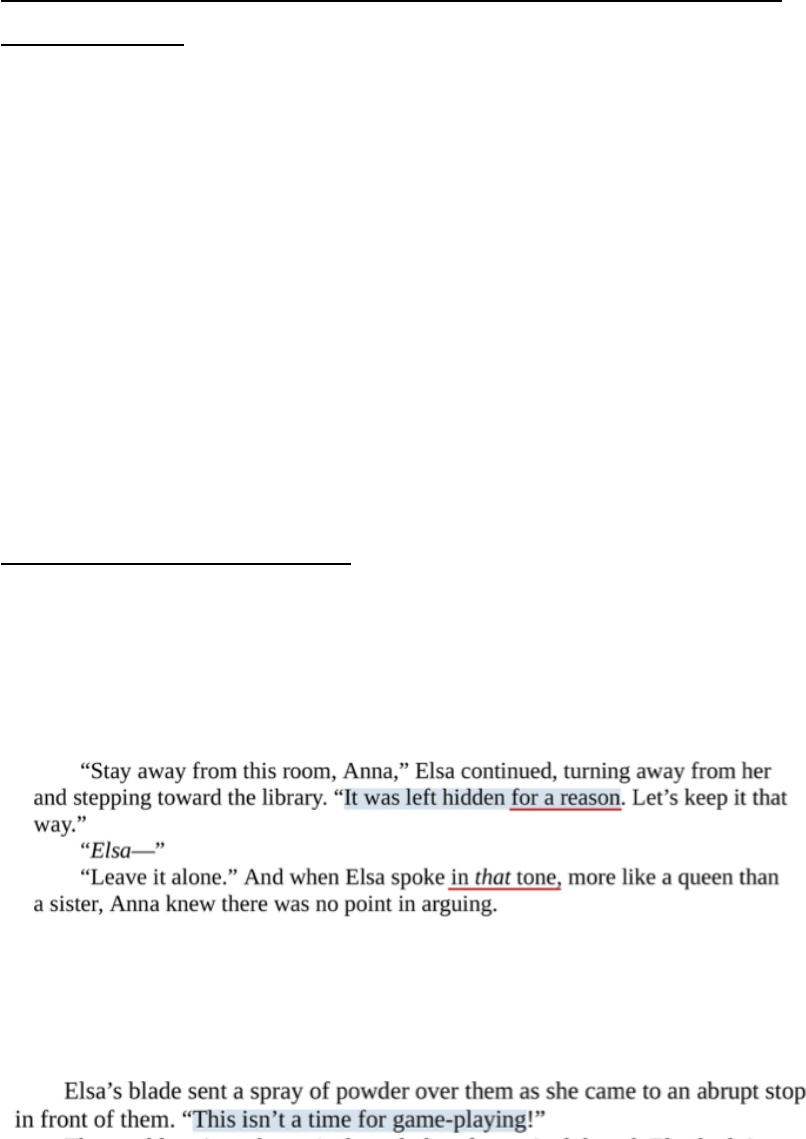
在这段情节里,艾莎的语气跟《冰雪奇缘1》里加冕典礼上的场景很像,坚定且强硬,不容争辩。具体原因稍后会详述。
(2)第12章
……
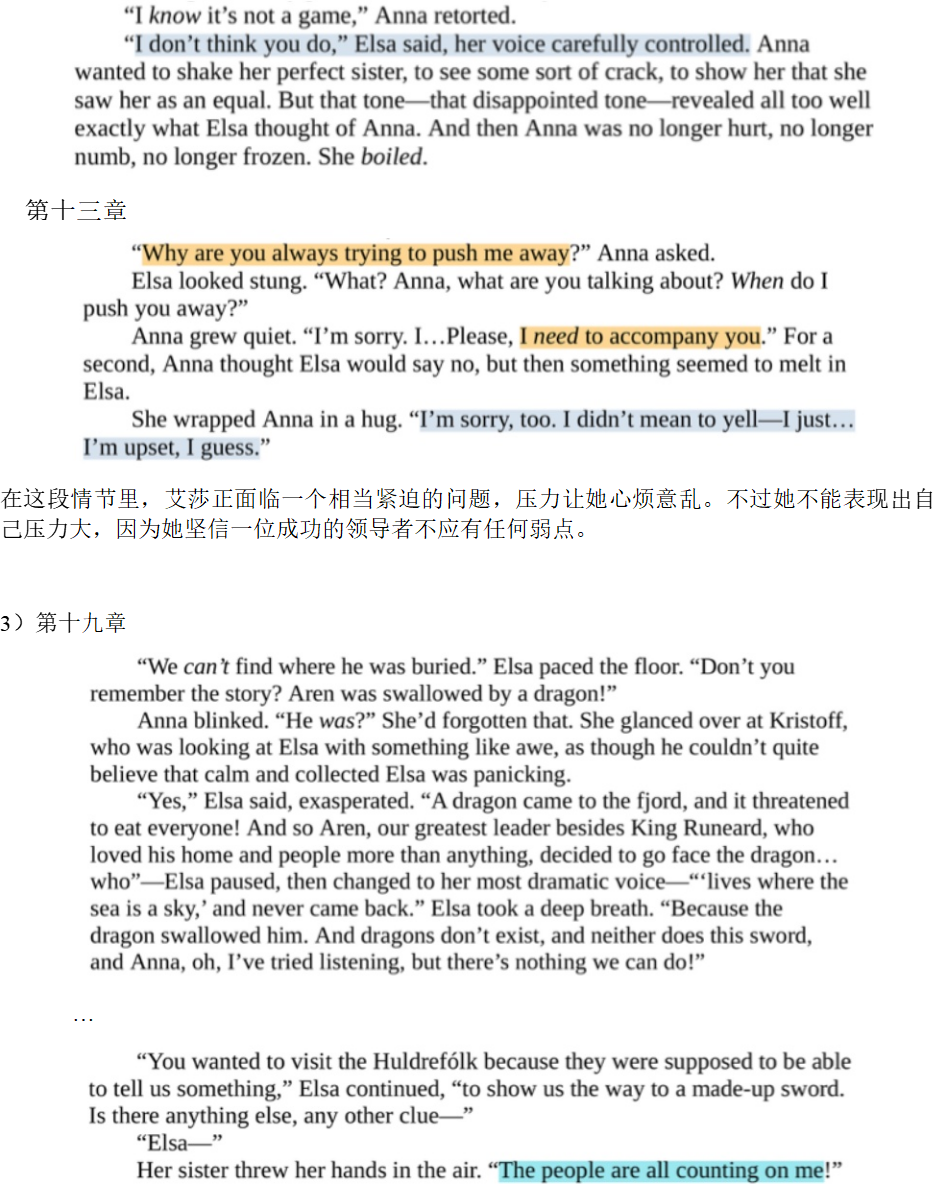
第13章
在这段情节里,艾莎正面临一个相当棘手的问题,压力正让她感到焦躁不安。然而,她不能表现出自己压力重重的样子,因为她坚信一位成功的领导者不应有任何弱点。
(3)第19章
……
在这段情节里,艾莎正深陷于绝望的情绪之中,因为拯救阿伦戴尔的最后一丝希望正在逐渐化为乌有。她觉得自己毫无用处,因为她没能找到”革命之剑”,这导致她没法去拯救阿伦戴尔,这让她更加坚信自己不是一个称职的女王。
在整部作品里,每当艾莎的情绪变得异常激烈,以至于”她听起来不像艾莎”时,那其实都是她在拼命地证明自己是一位称职的领导者,而非整个王国的罪人。在《暗影森林》中艾莎看似怪异的神情并非作者对她的刻画失误,而是源自于短期压力与长期精神问题交织在一起而产生的恐惧情绪所致。
- 由于叙述角度仅限于安娜的视角,所以存在一定的局限性。(确实如此!)
- 情节构思:在《暗影森林》这部作品里,主要的情节转折之一在于,是哪个人的梦魇催生出了纳特玛拉。倘若叙述视角是从艾莎的角度来写的,那么答案在故事的开头就会被揭晓。
- 从安娜的角度来看,《暗影森林》的剧情本身就已经够黑暗了;要是从艾莎的角度来写,那对于小孩子来说读起来就会太过压抑了。